Sell Your Isfahan Rug —
Free Valuation in 48 Hours
We buy fine hand-knotted Isfahan rugs — among the most refined weaving Persia has ever produced — including signed Seirafian workshop pieces and silk-foundation carpets. No fees. No obligation. Fair market offers.
What Makes an Isfahan Rug Exceptional
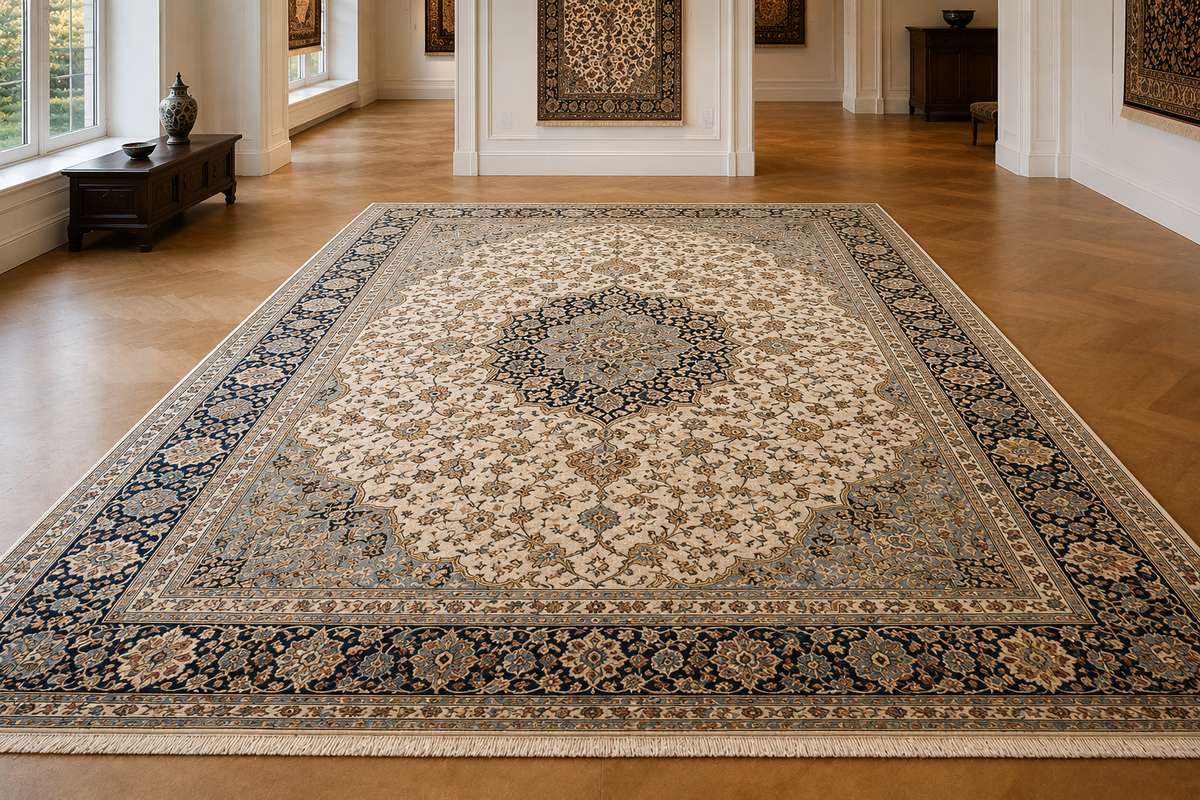
Isfahan rugs are woven in the central Iranian city of Isfahan — the former Safavid capital and, for centuries, one of the great centres of Persian art and architecture. That heritage shows in the rugs. Where a Heriz is bold and geometric, an Isfahan is refined, curvilinear and meticulously drawn: a precise central medallion, flowing arabesques, cloud bands, and the classic Shah Abbas palmette flowers, usually arranged with near-perfect symmetry around the field.
The craftsmanship is what places Isfahan among the most valued of all Persian rugs. Fine Isfahans are knotted with the asymmetric Persian knot at high density — frequently in the range of 300 to 700 knots per square inch, and higher still in the best workshop pieces. They are typically worked on a silk or cotton foundation with a low, tightly clipped pile of very fine wool, often lifted with silk highlights that catch the light. Grounds are frequently ivory or cream, set against deep blues and soft reds.
Because so much skilled labour goes into a single Isfahan, even a modest example represents months of work — and a fine signed piece can be a genuine collector's item. That is exactly why it pays to have an Isfahan valued by someone who understands the difference between a good Isfahan and an outstanding one.
The Seirafian Name — and Why a Signature Matters
If your rug carries the name "Seirafian" woven into its border, you may own something special. The Seirafian family workshop is the most celebrated name in twentieth-century Isfahan weaving. Its rugs are exceptionally finely knotted, frequently on a silk foundation, and use the finest wool and silk fibres — and a genuine signed Seirafian typically commands a considerable premium over an unsigned Isfahan of comparable size.
A woven signature or cartouche is one of the strongest pieces of evidence about a rug's origin and status, but it must be read carefully — signatures are sometimes copied, and workshop attributions need confirming against the weave itself. That is part of our assessment: we look at the signature, the knotting, the foundation and the drawing together before reaching a figure. If your Isfahan is signed, photograph the border cartouche closely so we can read it.
Send a clear close-up of any woven name or cartouche in the border, plus the front, reverse and fringe. We'll confirm the workshop and grade honestly as part of a free valuation. For the fuller story, read our complete guide to Isfahan carpets.
How to Sell Your Isfahan Rug in 3 Steps
No couriers, no appointments, no risk. The entire process is online.
Photograph Your Rug
Take photos in natural light: the full front face, the reverse (showing the knotting and foundation), the fringe, and a close detail of the pile. If the border carries a woven signature, photograph that too.
Pro tip: A close, sharp shot of the reverse tells us the knot density and whether the foundation is silk — both key to an Isfahan's value.
Submit via Our Quote Form
Upload your photos, add the dimensions, note the approximate age and origin if known, mention any signature, and describe condition — pile height, any repairs or fading.
Receive Your Offer
Our specialists review your Isfahan and respond within 48 business hours with a fair, market-rate offer. Accept, decline, or ask questions — no pressure, ever.
What Determines Your Isfahan Rug's Value
The factors we weigh on every Isfahan we assess.
Knot Density
Isfahans are prized for fine knotting; the tighter and finer the weave, the higher the value.
Foundation
A silk foundation, and silk highlights in the pile, typically lift value above an all-wool piece.
Signature
A genuine workshop signature — Seirafian above all — can raise value substantially.
Age
Fine mid-century and older Isfahans in good order are strongly sought by collectors.
Design
Balanced, elegant drawing and a harmonious palette all add to a rug's desirability.
Condition
Even, unworn pile and sound sides and ends matter — fine rugs are judged closely on condition.
Size
Both fine small format and well-proportioned larger Isfahans have their own strong markets.
Provenance
Certificates, dealer labels or family history all help support and raise value.
Why Sell Your Isfahan to Heritage Rug Buyers
Fine-Rug Expertise
Isfahans reward careful assessment. We read knot density, foundation, silk content and signatures properly, so your offer reflects the true quality of the piece.
Fast, Online Process
No need to carry a valuable rug across the country. Submit photos securely from your phone and hear back within 48 business hours.
Fair Market Prices
We price to the current collector and dealer market for fine Persian rugs — and explain every factor behind the number we reach.
No Fees, Ever
Our valuation is free. No commission, no buyer's premium, no storage costs. Decline the offer and you owe nothing.
Honest on Signatures
We confirm workshop attributions against the weave itself, so a claimed Seirafian is assessed properly — never taken at face value.
Discreet & Secure
Your photos and details are handled confidentially and never shared. Private sellers and estates trust us for exactly that.