Sell Your Tabriz Rug —
Free Valuation in 48 Hours
We buy authentic hand-knotted Tabriz rugs of every raj, design and age — from finely woven medallion carpets to antique Haji Jalili pieces. No fees. No obligation. Fair market offers.
What Makes a Tabriz Rug Distinctive
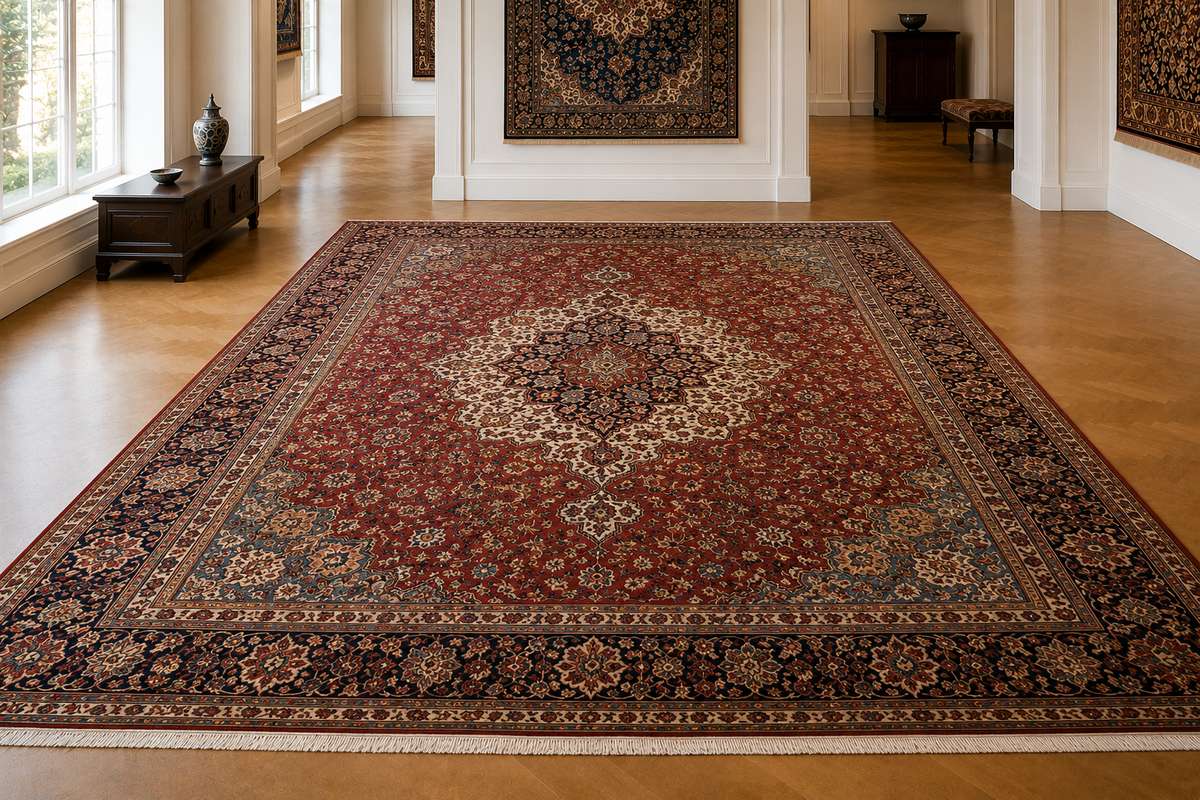
Tabriz is one of the oldest and most important rug-weaving cities in the world. Sitting in the East Azerbaijan province of north-west Iran, it has been a major commercial and artistic hub for centuries, and its weavers produce an extraordinary range — from utilitarian commercial rugs to some of the finest workshop carpets Persia has ever made. That range is the single most important thing to understand about a Tabriz: two rugs sharing the name can sit at completely different quality and price levels.
Design is famously varied. You'll find central-medallion layouts, all-over patterns, pictorial and hunting scenes, and above all the signature Mahi — the Herati or "fish" pattern, a small rosette flanked by curving, fish-shaped leaves repeated across the field. Palettes run from deep classical reds and blues to the soft ivories and creams of the finest antique pieces.
Construction is equally distinctive. Many Tabriz rugs are knotted on a cotton foundation, and — unusually among Persian cities — Tabriz weavers frequently use the symmetric Turkish knot, though some workshops use the asymmetric Persian knot. The pile is fine wool, often lifted with silk highlights, and the most luxurious pieces are woven entirely in silk.
Understanding Raj — the Key to a Tabriz's Value
Because Tabriz quality varies so widely, the trade uses a specific measure of fineness: the raj. Raj counts the number of knots across a span of roughly seven centimetres — the higher the raj, the finer and more tightly knotted the rug, the sharper its detail, and, generally, the greater its value. You'll hear pieces described as 30 raj, 40 raj, 50, 60, 70 raj and higher, with the very finest workshop carpets reaching the top of that scale.
A high raj alone doesn't decide value — age, design, materials and condition all matter — but it's one of the first things a specialist looks for, and it's why a coarse decorative Tabriz and a fine high-raj example can be worth so differently despite carrying the same name. The best antique Tabriz rugs, including those attributed to master weavers such as Haji Jalili in the late nineteenth century, combine fine raj with subtle drawing and restrained colour — and are actively sought by collectors.
Send a sharp close-up of the reverse alongside the full front. The density of knots on the back tells us the raj, and the design and colour tell us the era. We'll assess it honestly as part of a free valuation — read the full story in Tabriz Rugs Explained.
How to Sell Your Tabriz Rug in 3 Steps
No couriers, no appointments, no risk. The entire process is online.
Photograph Your Rug
Take photos in natural light: the full front face, the reverse (which reveals the knot density and raj), the fringe, and a close detail of the pile or medallion.
Pro tip: A sharp, close photo of the back is the single most useful image — it lets us read the raj and the foundation at a glance.
Submit via Our Quote Form
Upload your photos, add the dimensions, note the approximate age and any raj or workshop information you have, and describe condition — pile height, repairs, fading or any damage.
Receive Your Offer
Our specialists review your Tabriz and respond within 48 business hours with a fair, market-rate offer. Accept, decline, or ask questions — no pressure, ever.
What Determines Your Tabriz Rug's Value
The factors we weigh on every Tabriz we assess.
Raj (Fineness)
The higher the raj, the finer the weave and the sharper the detail — a primary value driver.
Materials
Fine wool, silk highlights, or full-silk construction each lift value in turn.
Age
Antique Tabriz rugs — especially fine 19th-century pieces — attract the strongest collector demand.
Workshop
A confirmed master attribution such as Haji Jalili can raise value substantially.
Design
Well-drawn Mahi, medallion or pictorial designs with balanced colour are more desirable.
Condition
Even pile and sound sides and ends help — though rarity and age can offset wear.
Size
Tabriz produces everything from small format to oversize carpets, each with its own market.
Provenance
Family history, dealer labels or old auction records all help support value.
Why Sell Your Tabriz to Heritage Rug Buyers
We Read Raj Properly
Tabriz quality spans a huge range. We assess raj, materials, design and age together, so your offer reflects where your rug genuinely sits — not a flat rate.
Fast, Online Process
No hauling a large carpet to an auction house. Submit photos securely from your phone and hear back within 48 business hours.
Fair Market Prices
We price to the current collector and dealer market, and explain every factor behind the number we reach.
No Fees, Ever
Our valuation is free. No commission, no buyer's premium, no storage costs. Decline the offer and you owe nothing.
Honest on Attribution
We confirm master attributions such as Haji Jalili against the weave and design — never taken at face value.
Discreet & Secure
Your photos and details are handled confidentially and never shared. Private sellers and estates trust us for exactly that.