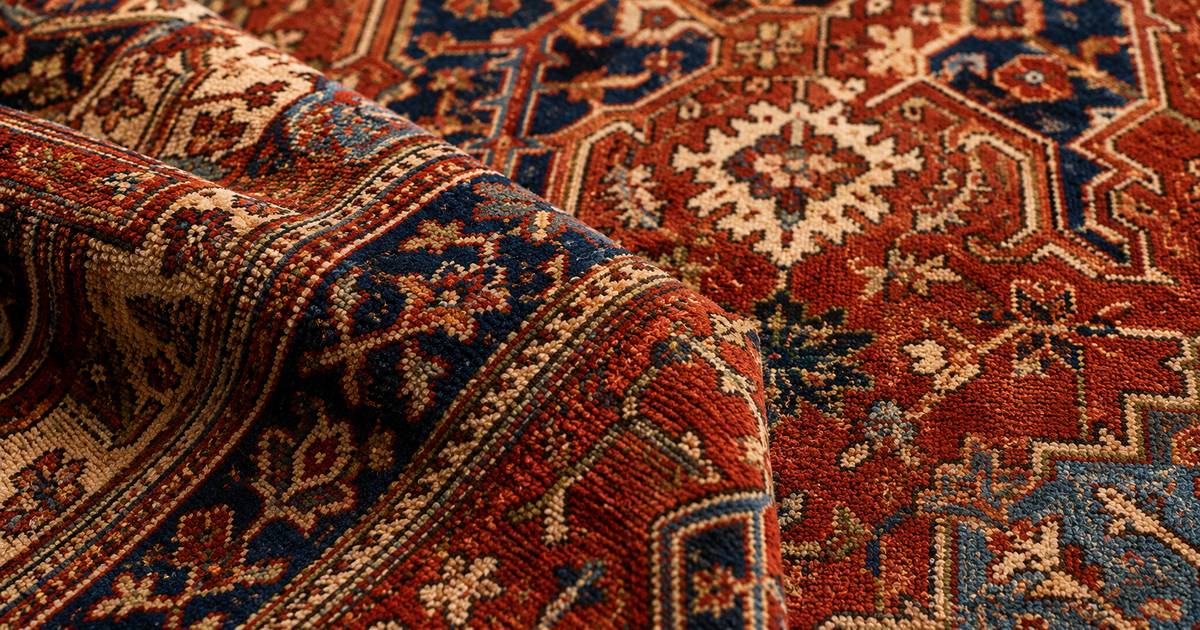
Ask any dealer to name a Persian rug that sells itself, and Heriz will be near the top of the list. It is one of a small handful of weaving styles that a non-specialist can often recognise on sight — and that recognition is a large part of its collectibility. But familiarity alone doesn't explain why fine Heriz rugs continue to attract serious money at auction and from private collectors. The real answer is a combination of design, material, history and grade.
Where Heriz Rugs Come From
Heriz rugs are woven in the town of Heriz and the cluster of villages around it, on the slopes of Mount Sabalan in the East Azerbaijan province of north-west Iran — not far from the great weaving city of Tabriz. This is rugged, mountainous country, and the weaving here has always had a robust, village character rather than the fine-drawn refinement of a city workshop. That difference is central to the appeal: a Heriz looks handmade, confident and unfussy, and collectors prize exactly that directness.
The style rose to prominence in the second half of the nineteenth century, when demand from Europe and especially the United States was strong. Room-sized Heriz carpets became a fixture of grand houses, and that long presence in Western interiors is one reason they remain so saleable today — the market for them is deep, established and international.
The Signature Look
The classic Heriz design is a large, angular geometric medallion dominating the centre of the field, usually with matching quarter-medallion spandrels in the corners and a strong, decisive border framing the whole. Where a city rug such as an Isfahan or Kashan renders its medallion in flowing, curvilinear florals, the Heriz translates the same idea into crisp, rectilinear shapes — hooks, angles and bold outlines.
The palette is just as recognisable: deep terracotta and rust-red grounds, navy and midnight-blue detailing, and ivory or cream highlights that make the geometry read clearly across a room. It is a design that works in a country drawing room and a modern minimalist apartment alike, which is a big part of why demand has never really faded. If you want to place a Heriz among its Persian cousins, our guide on how to identify a Persian rug sets out the wider family.
The Wool That Makes Them Last
Design gets a Heriz noticed; wool is what makes it last. Heriz rugs are typically knotted with a durable cotton warp foundation and a pile of tough local wool, and that wool has a near-legendary reputation for resilience. Weavers and dealers have long attributed its toughness to trace copper in the water the local sheep drink. Whatever the precise cause, the practical result is a rug that can be walked on for generations and still hold its pile and colour.
For collectors, durability is not a minor virtue. A rug that survives a century of use in good order is far more likely to reach the market as a desirable antique than a delicate piece that wears thin. The Heriz's hard-wearing nature means well-kept antique examples are genuinely available — and genuinely usable — rather than being fragile relics to be kept behind glass.
Serapi: The Finest Grade of Heriz
If there is one word that lifts a Heriz into a higher bracket, it is Serapi. Since the early twentieth century, Serapi has been the trade term for the finest grade of Heriz — generally the older pieces, woven with finer wool and a higher knot count. Compared with a standard Heriz, a Serapi shows more spacious, open drawing, more graceful curves within the geometric framework, and subtler, more sophisticated transitions of colour.
This distinction has real consequences for value. Two rugs woven a few miles apart in the same district can sit at very different price levels: a finely woven antique Serapi with soft, naturally dyed colours is a collector's piece, while a later, more coarsely knotted commercial Heriz is a handsome decorative rug valued more modestly. The word "Serapi" on a description is therefore worth understanding — and worth verifying against the weave itself, which is part of what a specialist does when assessing one.
Thinking of selling a Heriz or Serapi?
Our specialists will tell you honestly where your rug sits — including whether it reaches Serapi grade — and what it's worth, at no cost and with no obligation.
Get a Free Heriz ValuationWhat Makes One Heriz More Collectible Than Another
Not all Heriz rugs are equal. When we assess one, these are the factors that most affect desirability and value:
- Grade: A fine Serapi-grade piece sits well above a later commercial Heriz of the same size. Fineness of weave is the single biggest divider.
- Age: Late-nineteenth and early-twentieth century Heriz and Serapi rugs attract the strongest collector demand. Genuine antiques carry a premium over mid-century and later pieces.
- Dyes: Soft, natural vegetable dyes that have mellowed over decades are far more desirable than harsh, uniform synthetics. Gentle tonal variation — abrash — is prized, not penalised.
- Drawing: A well-proportioned, confidently drawn medallion with balanced spandrels and a harmonious border is worth more than a crowded or awkwardly spaced design.
- Size: Generous room-size and oversize Heriz carpets are especially sought after, because large antique rugs in good condition are relatively scarce.
- Condition: Even pile, sound sides and ends, and minimal repair all help — though, as with most antiques, great age and rarity can offset a degree of honest wear.
Why the Market Stays Strong
Collector fashions come and go, but Heriz rugs have proved unusually resilient. Three things sustain them. First, recognisability — buyers know and trust the look, which keeps a broad base of demand. Second, durability — the supply of usable antique examples is healthy because the rugs survive. Third, versatility — the bold geometry suits a wide range of interiors, so Heriz rugs appeal to decorators and collectors at once. Together these factors give the style a stability that more niche weaving traditions can lack.
None of this makes any individual rug a guaranteed investment. As with all antiques, a Heriz should be bought and sold on its own merits — its grade, age, dyes, size and condition — rather than on the strength of the name alone. But the underlying demand for good Heriz rugs is about as dependable as it gets in the Persian rug market.
How to Tell What You Have
If you own a rug you think may be a Heriz, start with the design and the back. On the front, look for the angular central medallion, corner spandrels and a rust-red ground. Turn it over: a genuine Heriz shows the pattern clearly in reverse, with a cotton foundation and the individual knots visible. Handle the wool — good Heriz wool feels substantial and slightly lustrous. To weigh it against other Persian styles, our guide to identifying a Persian rug and our overview of what affects rug value are useful next reads.
Working out whether a piece reaches Serapi grade, and how old it really is, takes an experienced eye — the kind of judgement that separates a modest decorative offer from a collector-level figure. That is exactly the assessment we provide, free and without obligation, when you send us photographs.