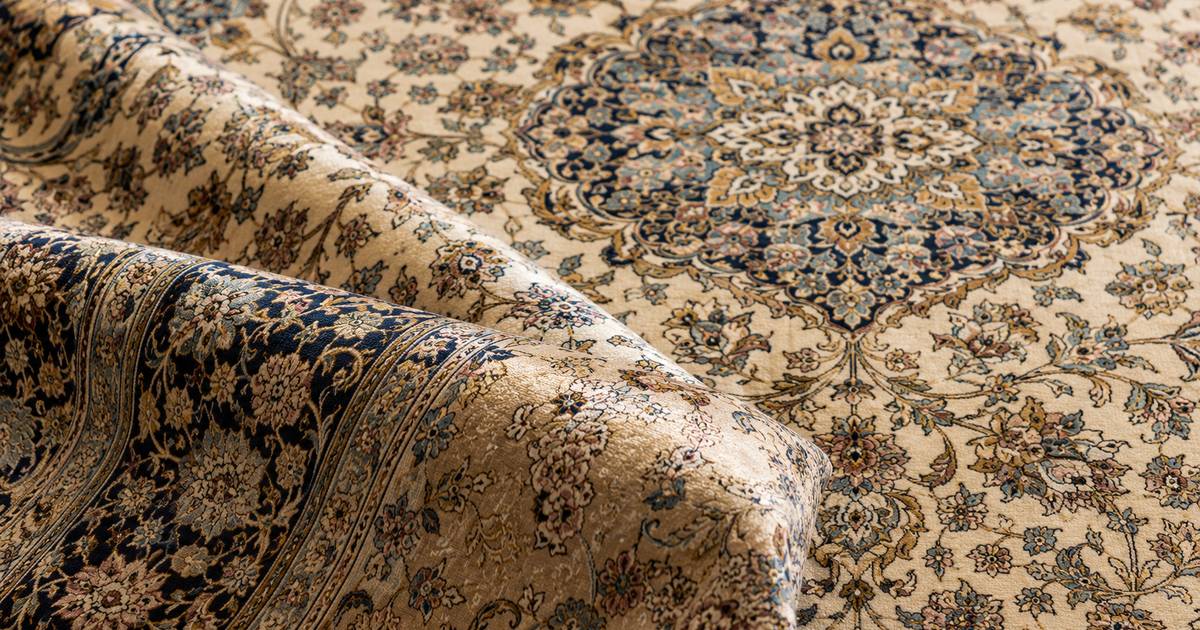
If Heriz is the great village rug of north-west Iran, Isfahan is the city masterpiece of the centre. Woven in a place synonymous with Persian art and architecture, Isfahan carpets stand for precision, delicacy and controlled elegance. For collectors and sellers alike, understanding what makes an Isfahan special — and what separates a good one from an outstanding one — is the key to knowing what you have.
A City With an Artistic Heritage
Isfahan sits in central Iran and was, under the Safavid dynasty, the capital of the empire and one of the great centres of Persian art. That heritage is not incidental to its rugs: the design language of the Isfahan carpet draws directly on the same courtly, curvilinear aesthetic seen in the city's tilework and manuscript illumination. When you look at a fine Isfahan, you are looking at a woven expression of a specific and sophisticated artistic tradition.
The result is a rug quite different in spirit from the bold geometry of a Heriz or the tribal directness of a Qashqai. Where those styles are confident and rustic, the Isfahan is measured, symmetrical and finely drawn.
The Isfahan Design Language
The classic Isfahan is built around a precise central medallion, set on a field of flowing arabesques and the palmette flowers known as Shah Abbas motifs, often with cloud bands and delicate vine scrolls. The whole is usually arranged with near-perfect symmetry, and the drawing is curvilinear throughout — graceful curves rather than angular shapes. Grounds are frequently ivory or cream, set against deep indigo blues and soft reds, a palette that gives the best Isfahans a luminous, almost lit-from-within quality.
This refinement places Isfahan among the most consistently well-regarded of all Persian city rugs in the Western market. To see how it fits within the wider Persian family, our guide on how to identify a Persian rug compares Isfahan with Kashan, Tabriz, Qom and the tribal traditions.
From Cartoon to Carpet: The Workshop Tradition
The exactness of an Isfahan is not improvised at the loom — it is planned. Elaborate curvilinear designs are first drawn to scale, in their proper colours, on squared paper; each square stands for a single knot. This coloured plan is called the cartoon (in Persian, naqsheh — literally "map" or "design"), and the weaver follows it knot by knot to reproduce the pattern faithfully. In traditional workshops the design was often called out aloud to the weavers row by row, a practice known as naqshe-khani, "reading the design". It is this disciplined, plan-driven method — rather than the freehand memory of a village weaver — that lets an Isfahan achieve its precise, mirror-symmetrical drawing.
The tradition reaches back to the Safavid court manufactories, where royal ateliers in Isfahan produced masterpieces destined for palaces, foreign courts and great mosques. That courtly setting also shaped the layout itself: the classic medallion-on-a-field composition echoes the domed interiors of Safavid architecture — the central medallion mirroring a domed ceiling, much as the celebrated Ardabil Carpet was conceived. When you look at a fine Isfahan, you are looking at architecture translated into wool and silk.
How Isfahan Carpets Are Made
The craftsmanship is where the value lies. Fine Isfahans are knotted with the asymmetric Persian knot at high density — frequently in the range of several hundred knots per square inch, and higher still in the best workshop pieces. They are typically worked on a silk or cotton foundation, with a low, tightly clipped pile of very fine wool that is often lifted with silk highlights to catch the light.
Two construction details matter especially for value:
- Knot density: The finer and tighter the knotting, the more detail the weaver can achieve and the higher the value. Isfahan is prized precisely for this fineness.
- Foundation: A silk foundation — visible as fine, lustrous, strong warp threads at the fringe — generally sits above an all-cotton foundation in value, and usually pairs with a very low, tight pile.
Because so much skilled labour goes into a single Isfahan, even a modest example represents months of work. A fine signed piece can be a genuine collector's item — which brings us to the most important name in Isfahan weaving.
Own an Isfahan and want to know its value?
Send us photos of the front, reverse, fringe and any signature. We'll assess knot density, foundation, silk content and workshop — free, and with no obligation to sell.
Get a Free Isfahan ValuationThe Seirafian Workshop
No account of Isfahan carpets is complete without the Seirafian name. The Seirafian family workshop is the most celebrated in twentieth-century Isfahan weaving, and its rugs are benchmarks of quality: exceptionally finely knotted, frequently on a silk foundation, and made with the finest wool and silk fibres. A genuine Seirafian piece usually carries the Seirafian name woven into the border as a signature or cartouche.
That signature matters commercially. A confirmed, signed Seirafian typically commands a considerable premium over an unsigned Isfahan of comparable size and quality — the workshop's reputation is that strong. But a woven name must always be read carefully. Signatures are sometimes copied, and a workshop attribution needs to be confirmed against the weave, the foundation and the drawing, not accepted on the strength of the border alone. When we assess a possible Seirafian, we look at all of these together before reaching a figure.
If your rug carries a woven name in the border, photograph it closely and in good light — it is one of the single most useful pieces of evidence about the rug's origin and status.
How to Judge an Isfahan's Quality
When we assess an Isfahan, these are the factors that most shape value:
- Knot density: The finer the weave, the higher the value. This is the first thing a specialist checks on the reverse.
- Foundation and silk content: A silk foundation and silk highlights in the pile lift value above an all-wool piece.
- Signature: A genuine, confirmed workshop signature — Seirafian above all — can raise value substantially.
- Age and condition: Fine mid-century and older Isfahans in good, even condition are strongly sought. Fine rugs are judged closely on condition, though quality can offset moderate wear.
- Design and palette: Balanced, elegant drawing and a harmonious colour scheme add to desirability.
- Provenance: Certificates, dealer labels or documented family history all help support value.
For a broader view of how these elements interact across all rug types, our overview of what affects rug value is a useful companion read.
Isfahan in the Wider Persian Market
Among Persian city rugs, Isfahan occupies a rarefied position alongside Kashan, Nain and the silk rugs of Qom. It appeals to buyers who want refinement and fineness rather than the bold statement of a Heriz or the range of a Tabriz. That said, quality within the Isfahan name varies, and the gap between a good decorative Isfahan and a fine signed workshop piece is very wide — which is exactly why an expert assessment is worth having before you sell.
If you are weighing an Isfahan against other Persian styles you may own, our guides to Tabriz rugs and why Heriz rugs are so collectible round out the picture of the three great weaving traditions of Iran covered in this series.